
Hi, I’m Sivanesan, a final-year B.Tech student in Artificial Intelligence and Data Science at Kumaraguru College of Technology. I’m deeply passionate about AI and how it’s shaping the future. This is my very first blog, and I’m thrilled to share my journey, experiences, and insights with you. Whether you're here for some tech talk or just curious about my story, I hope you'll stick around. Let’s get started!
1. Introduction
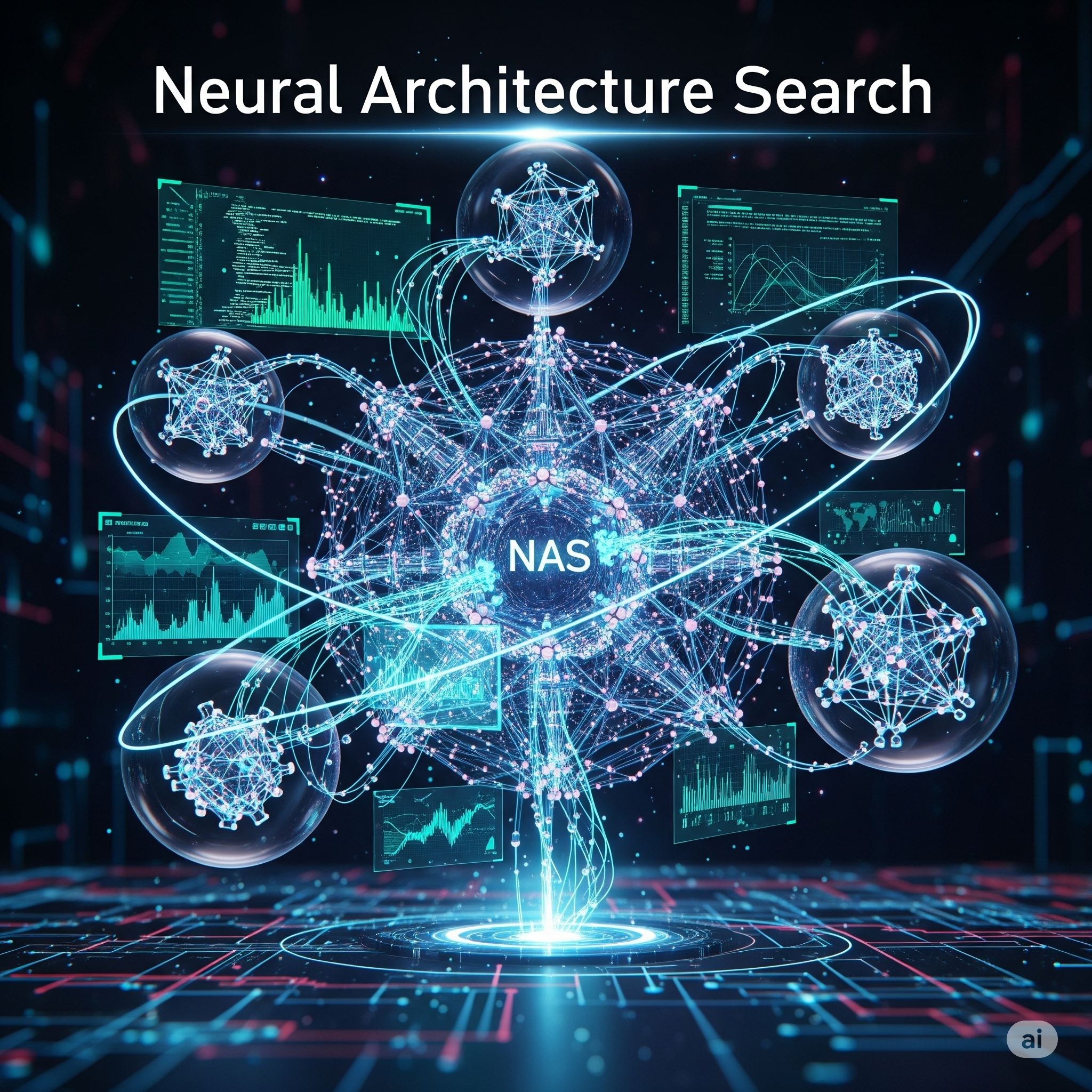
Imagine a world where AI doesn’t just learn — it designs itself. Welcome to the era of Neural Architecture Search (NAS). This cutting-edge technique automates the process of discovering the most effective neural network architecture for a given task. Instead of relying on manual experimentation, NAS uses algorithms to explore countless model configurations, dramatically speeding up innovation and reducing the need for human guesswork.
Example: Like Chitti Designing a Smarter Version of Himself
Think of NAS like Chitti, the robot from Enthiran. Imagine Chitti wasn’t just powerful but also smart enough to design a better version of himself—faster, stronger, and more efficient—without needing Vaseegaran’s help.
That’s what Neural Architecture Search does.
Just like Chitti could analyze millions of possibilities in seconds, NAS explores countless neural network designs—testing which combination of layers, neurons, and connections works best for a task (like image recognition or speech translation). It learns from each design and keeps improving automatically.
In short:
NAS = Chitti designing Chitti 2.0
2. What is Neural Architecture Search (NAS)?
Neural Architecture Search (NAS) is a powerful machine learning technique where AI designs better AI.
Instead of humans manually crafting neural network architectures (like CNNs or RNNs), NAS automates the process—finding the optimal design for a specific task, such as image classification, language translation, or speech recognition.
In short:
- Traditional AI: Humans build models.
- NAS: AI builds models.
Key Components of NAS:
1. Search Space
The universe of possible neural network architectures. It defines what the AI is allowed to try—like types of layers, activation functions, or connections.
2. Search Strategy
The brain behind the exploration. It decides how to navigate the search space. Common strategies include:
- Reinforcement Learning (RL)
- Evolutionary Algorithms
- Bayesian Optimization
- Gradient-based methods
3. Evaluation Strategy
How each candidate model is judged. It usually involves:
- Training the model (fully or partially)
- Testing it on validation data
- Scoring it based on accuracy, speed, or resource usage
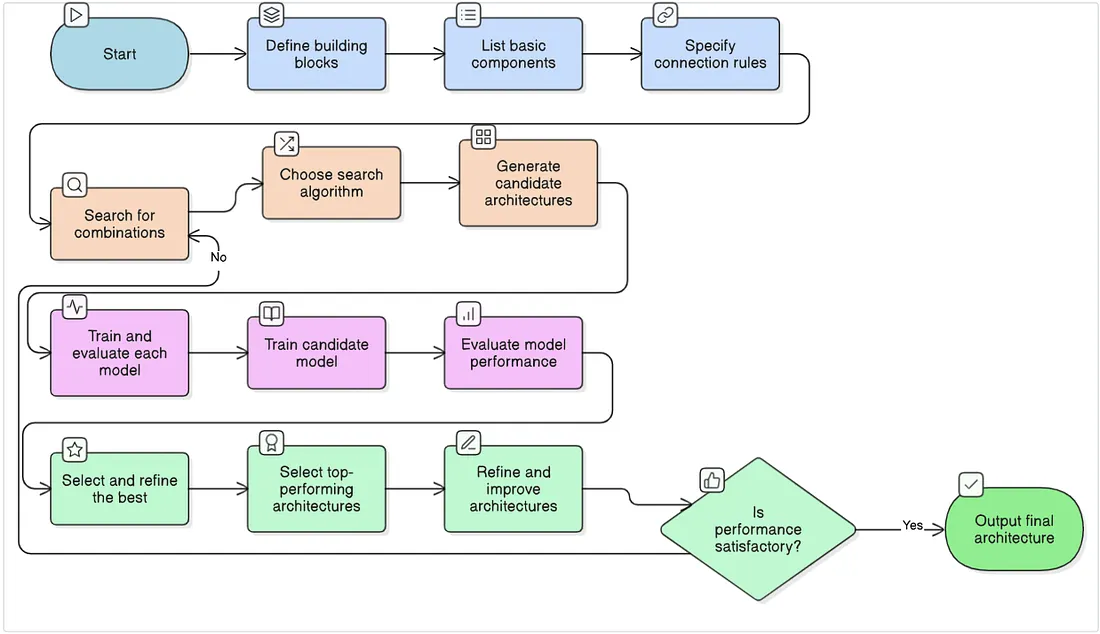
3. How NAS Works (Simplified)
-
Define the building blocks
Start by listing the basic components like layers (e.g., convolution, pooling) and how they can connect—like LEGO pieces for neural networks. -
Search for combinations
Use a search algorithm (random search, reinforcement learning, evolution, etc.) to explore different architectures—similar to trial-and-error. -
Train and evaluate each model
Each candidate architecture is trained (like a student learning) and tested on a task to see how well it performs. -
Select and refine the best
The top-performing architectures are kept and improved over time—like keeping the best students and helping them grow smarter.
Visual Aid:
4. Popular Approaches to NAS
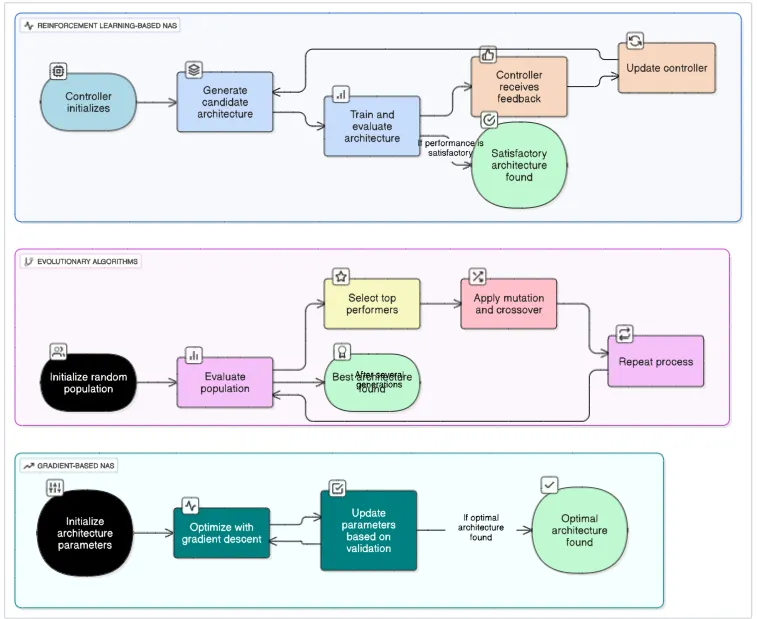
1. Reinforcement Learning-based NAS
A controller (often an RNN) generates network architectures. It receives feedback based on how well the architecture performs and learns to generate better ones over time — like a gamer learning through rewards.
2. Evolutionary Algorithms
Inspired by Darwin’s theory of evolution:
- Start with a population of random architectures
- Apply mutations and crossover
- Keep the best performers
Over generations, the models “evolve” to become better.
3. Gradient-based NAS
Uses gradient descent to directly optimize architecture parameters.
- Much faster than other methods
- Requires continuous/relaxable search spaces
- Techniques like DARTS (Differentiable Architecture Search) are popular in this category
Visual Aid:
5. Real-World Impact: Google AutoML
Google’s AutoML leverages Neural Architecture Search (NAS) to automatically design high-performing models—often surpassing those crafted by human experts.
It has been successfully applied to tasks like:
- Image Classification
- Object Detection
- Natural Language Processing
What makes AutoML powerful is its accessibility—it empowers non-experts to build top-tier AI systems without deep knowledge of neural network design.
6. Challenges in NAS
- Expensive: Searching for the best architecture requires massive computational resources—often needing hundreds of GPUs or TPUs.
- Time-Consuming: Each candidate model must be trained and evaluated, which makes the entire search process very slow.
- Risk of Overfitting: NAS might overfit to the validation set it uses during search, especially if the search space or dataset is small.
7. The Future of NAS
One-shot NAS
Instead of training each model from scratch, a supernet is trained once. Multiple architectures are then evaluated by sharing weights—making the search much faster and cheaper.
Hardware-aware NAS
Designs architectures not just for accuracy, but also for efficiency on specific devices (e.g., smartphones, edge devices). It balances performance with constraints like latency, memory, and power usage.
Few-shot NAS
Aims to reduce the amount of data and compute needed during search, making NAS more accessible in low-resource settings.
8. Why NAS Matters
Neural Architecture Search (NAS) democratizes AI by automating the design of powerful models—no deep machine learning expertise required.
It empowers:
- Developers without AI backgrounds
- Startups without large research teams
- Industries seeking custom, optimized solutions
By making AI more accessible, efficient, and adaptable, NAS is paving the way for smarter systems across healthcare, finance, manufacturing, and beyond.
Final Thoughts
Neural Architecture Search (NAS) is AI building better AI — a bold step toward truly autonomous intelligence.
Though still evolving, NAS holds the power to redefine how we design deep learning models, shifting from manual engineering to automated optimization.
As computing becomes faster, cheaper, and more intelligent, NAS will likely sit at the heart of the next wave of AI breakthroughs — accelerating innovation across every field it touches.
Thanks for Reading!
Thanks for taking the time to read my post on Neural Architecture Search (NAS). I hope it gave you a clear and simplified understanding of how AI is evolving to design itself.
I’d love to hear your thoughts or questions in the comments!
Let’s grow and learn together in the world of AI.

Join the Discussion (0)
Comments via GitHub Discussions: This blog uses Giscus, which leverages GitHub Discussions for comments.
You'll need a GitHub account to comment. Comments will appear in a dedicated Discussion category within the blog's repository.