Hi, I’m Sivanesan, a final-year B.Tech student in Artificial Intelligence and Data Science at Kumaraguru College of Technology. I’m deeply passionate about AI and how it’s shaping the future. This is my very first blog, and I’m thrilled to share my journey, experiences, and insights with you. Whether you're here for some tech talk or just curious about my story, I hope you'll stick around. Let’s get started!
1. Introduction
Neural networks have revolutionized the field of artificial intelligence, powering everything from voice assistants to self-driving cars. At their core, these models learn patterns from data and make predictions based on that learning.
However, unlike the human brain, neural networks struggle with one major flaw—catastrophic forgetting. This occurs when a model trained sequentially on multiple tasks forgets earlier tasks while learning new ones. This poses a serious challenge for continual learning systems expected to adapt without losing prior knowledge.
2. What is Catastrophic Forgetting?
Just like how humans sometimes forget old memories when learning something new, neural networks can also forget previously learned tasks when trained on new ones. This is known as catastrophic forgetting.
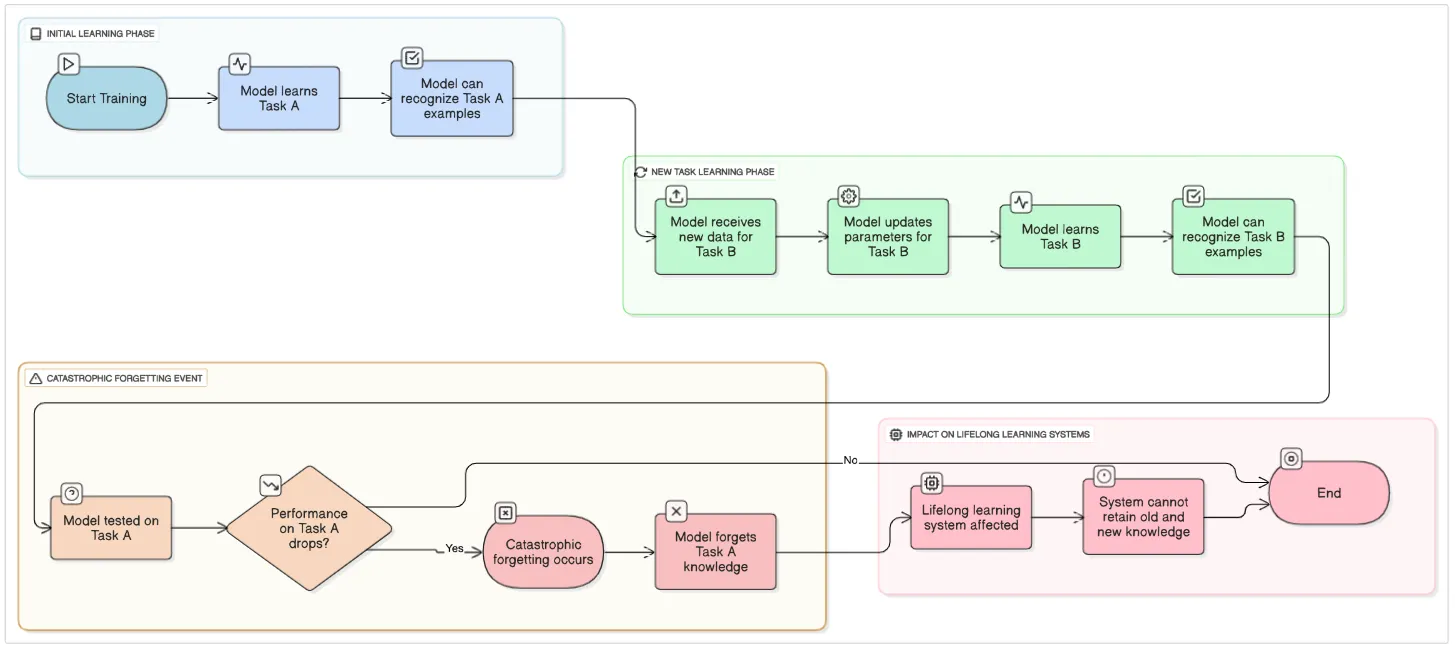
Example (Inspired by Anniyan): Think of a neural network like Ambi from the Tamil movie Anniyan. Ambi is a strict rule-follower, but when his other personality, Anniyan, takes over, he forgets how he used to behave. Similarly, a model trained to recognize cats, when later trained to recognize birds, may forget how to recognize dogs—it overwrites the old with the new.
Why does it matter? In real-world systems—like virtual assistants or learning robots—we want them to learn new things without forgetting what they already knew. Catastrophic forgetting blocks this, making lifelong learning hard.
3. Why Common Solutions Aren’t Enough
Researchers have proposed methods like:
- EWC (Elastic Weight Consolidation): Slows changes to important weights.
- Rehearsal Methods: Replays old task data while learning new ones.
- Fine-Tuning: Gradual adjustment of weights to balance old and new tasks.
But all these have issues:
- Rehearsal needs storing old data — which isn’t always privacy-friendly or practical.
- EWC and fine-tuning can be slow, computationally heavy, and not always effective.
4. A Brain-Inspired Solution: Dual Networks + Memory Replay
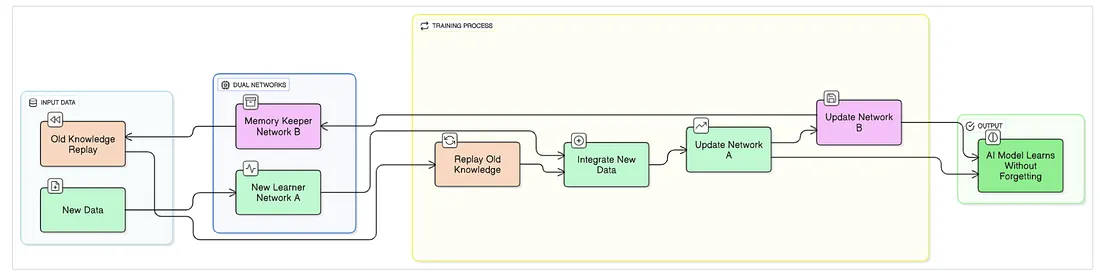
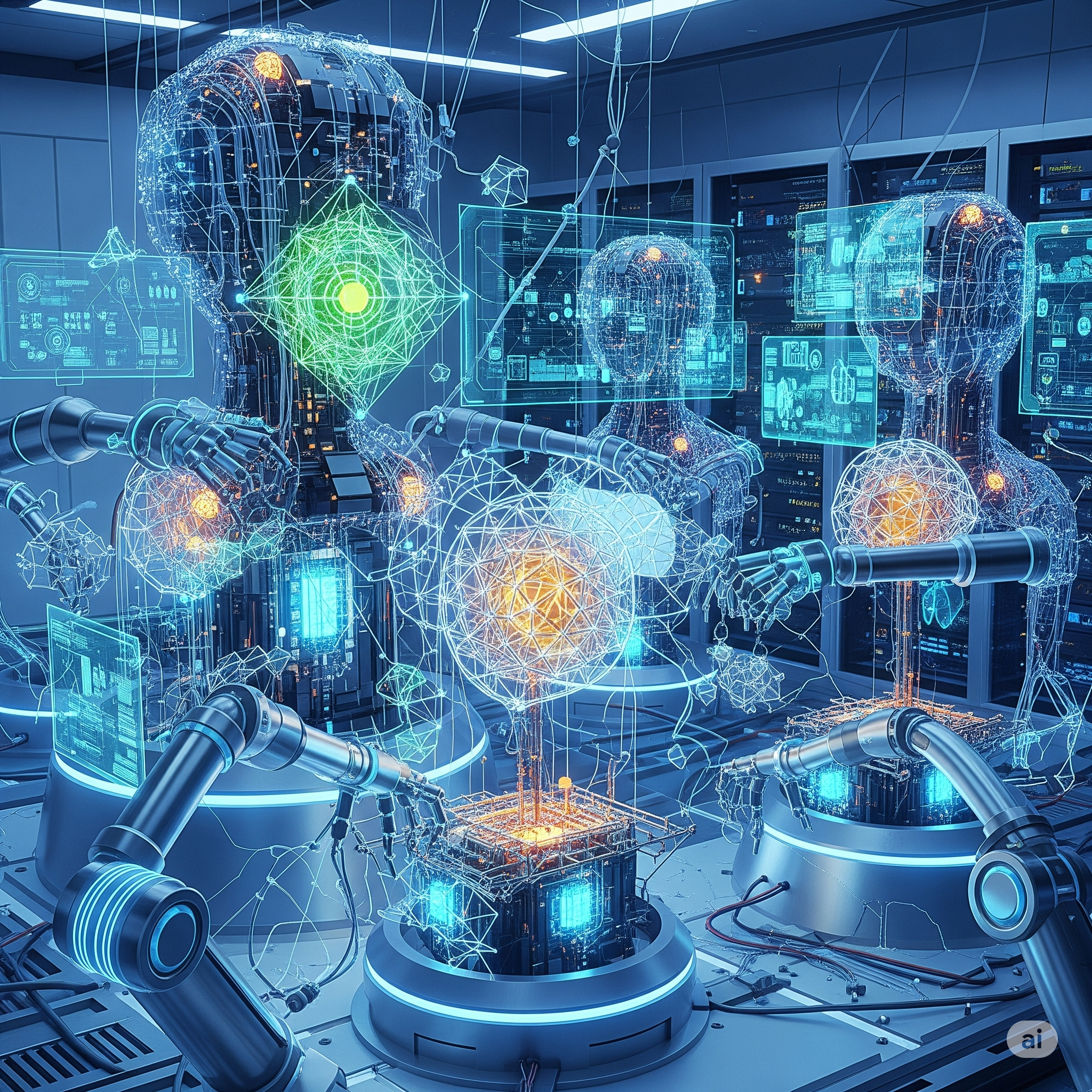
Inspired by how the hippocampus and cortex in the brain work, we design a dual-network system:
- Network A (New Learner): Learns new tasks quickly.
- Network B (Memory Keeper): Retains compressed knowledge of older tasks.
How it works:
- New data is sent to Network A for quick learning.
- Old knowledge from Network B is replayed during training—like mental flashbacks.
Real-world analogy (again, from Anniyan): Ambi = Network B (remembers old), Anniyan = Network A (learns new). Over time, they learn to coexist.
5. Benefits of This Approach
- No Need to Store Full Datasets: Compact memory replay from Network B reduces data storage needs.
- Biologically Inspired = Better Generalization: Mimics fast and slow learning separation in the human brain.
- Scalable: Ideal for edge AI, virtual assistants, robots, and other real-world applications.
6. Conclusion
Catastrophic forgetting is one of the biggest hurdles to building lifelong learning AI systems. But by drawing inspiration from the brain—and building dual-network architectures—we can help AI learn new things without wiping the old.
What’s Next?
- Integrating with large language models like GPT for multi-domain knowledge retention.
- Adapting the system in real-time robotics environments.
- Exploring efficient implementations on edge devices.
Join the Discussion (0)
Comments via GitHub Discussions: This blog uses Giscus, which leverages GitHub Discussions for comments.
You'll need a GitHub account to comment. Comments will appear in a dedicated Discussion category within the blog's repository.